I’ve been a writer as long as I can remember. In 5th grade, I started my first of three volumes of poetry. Somewhere in my closet there are upwards of nine completely filled journals, and my college essay was about writer’s block. You would think with the thousands of words I’ve penned and the sentences I’ve typed, writing would be something I could easily explain.
It’s not.
In fact, it’s probably one of the hardest things to articulate. There are no words to describe writing. However, that all changed when I took my Writing for Magazines class.
Second semester senior year, I decided to take an english class with a man named Jeff. I hope he never reads this post because it will be littered with clichés (and he hates clichés), but he is the only person to describe how I feel as a writer. On the very first day of class, I literally sat in awe of this crotchety, hardened journalist with his wide-rimmed classes and faded baseball hat. Throughout the semester, he found the words I had been searching for, ripped my work apart and taught me everything I needed to know about writing.
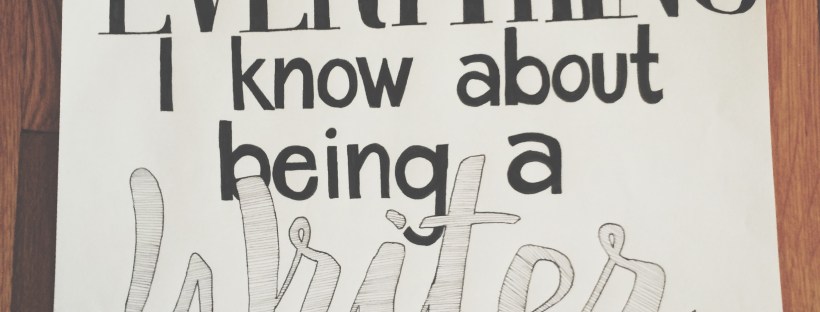
And since his class, I’ve learned a few things too. So for all you writers out there, here’s everything I know about being a writer.
There are shades of words, pick the right one.
When I wrote in-class essays in high school, I would tap my nose. Not all the time, just when I couldn’t think of the right word. The more I write, the more I realize how many different words there are & how fun/frustrating/rewarding/infuriating it is to play with them. Words have connotations. They have emotion. There are thousands of different shades between “good” and “extraordinary,” so pick the right one because it could change everything.
You might be a writer, but you’re also a psychologist.
This particularly applies to when you’re interviewing someone. It’s hard. Like way harder than you would think. You’re in a completely artificial situation, yet you have to make it seem like a natural conversation. You have to uncover hidden desires and feelings without being too pushy. Surface information is great, but people’s true personalities live way beneath that. As a writer, your job is to figure out your interviewee like a detective, but treat them like a friend.
You have to lead readers through a piece, but they’re not stupid.
 Jeff emphasized the importance of a focus in a piece. You need a clear sentence or topic that you entire piece will revolve around. Readers like focuses. It helps them stay on track.
However, you don’t need to spell everything out for readers. They’re smart. They will pick up on hints, innuendos and subtle foreshadowing. But you also have to make sure you give them some sort of resolution at the end. You can have a plot twist in your story, but your readers have to be able to make sense of it afterwards.
First drafts are sh*tty. Let them be.
 Nothing is more intimidating than a blank screen and a blinking cursor. Jeff once said, “The first word you write eliminates half of the possible directions of your piece. The second word cuts them in half again.” Talk about pressure. I would get so paralyzed by my need of perfection that I couldn’t write my first drafts. That was until Jeff tore up a first draft of mine in front of my face.
His point? First drafts suck. Let them suck. First drafts are for getting your thoughts out on paper. Who cares about first drafts, no one is going to see them. Sometimes it’s hard to get it out, but once you get rolling it’s easier. Then re-writing is where the fun begins.
There are rules. And you can break them.
 Grammar is important. Cohesion is important. Intros, bodies and conclusions are important. Starting a sentence with a conjunction or adding a period for emphasis? Not a big deal. Since middle school we’ve learned the ins and outs of formal writing, when in reality it’s only good for college assignments and academic literature. Develop a voice and play around with rhythm. Know the rules well enough to break them.
You’re going to hate most of what you write.
It’s true. I do hate most of the things I write. Even the things that multiple editors look at and publish. But there are always those few magical sentences in every piece that make it worthwhile. Writing is probably the hardest thing I’ve ever done, but I can’t imagine pursuing anything else.
May your writing be effortless and your writer’s block be brief.
Featured image by Krista.



 Ampersand